
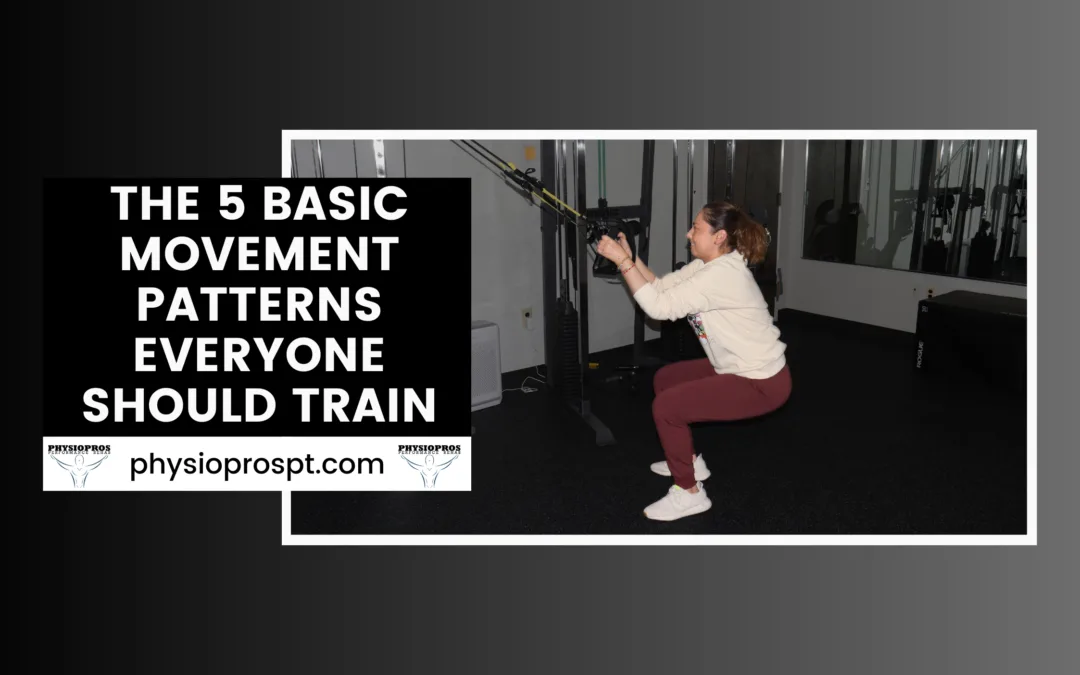
The 5 Basic Movement Patterns Everyone Should Train.
When people think about exercise, they often focus on individual muscles—strong abs, toned arms, or bigger legs. However, the body doesn’t actually move muscle by muscle. Instead, it moves through coordinated patterns that involve multiple joints and muscle groups working together. These patterns are what allow you to sit, stand, lift, reach, walk, and react safely in everyday life.
That’s why understanding and training basic movement patterns is so important. Whether you’re an athlete, a desk worker, or someone simply trying to stay active and pain-free, these patterns form the foundation of how you move. At Physiopros Performance Rehab in Parsippany, NJ, we emphasize movement patterns because improving them often leads to better strength, fewer injuries, and more confident movement overall.
Rather than chasing endless exercises, focusing on these five core patterns helps your training and physical therapy carry over into real life.
Why Movement Patterns Matter More Than Individual Exercises
Your body is designed to move as a system. When one part doesn’t do its job well, another part compensates. Over time, those compensations can lead to stiffness, overuse, or pain.
Training movement patterns helps:
Improve coordination between joints and muscles
Reduce unnecessary strain on specific areas
Build strength that transfers to daily tasks
Improve balance and control
Lower the risk of recurring injuries
Instead of asking, “What muscle should I work today?” a better question is, “How does my body need to move better?”
With that in mind, let’s break down the five basic movement patterns everyone should train.
1. Squat Pattern
The squat pattern is one of the most fundamental movements humans perform. It shows up when you sit down, stand up, pick something up from a low surface, or get in and out of a car.
A good squat pattern requires:
Hip and knee coordination
Ankle mobility
Core stability
Upright posture
When the squat pattern is limited, people often notice knee pain, lower back discomfort, or difficulty with daily activities. Poor squatting mechanics are also commonly linked to gym injuries.
Training the squat pattern improves lower-body strength while teaching the hips and knees to share load more efficiently. Variations can range from sit-to-stand movements to goblet squats or bodyweight box squats, depending on the individual.
2. Hinge Pattern
The hinge pattern is different from the squat, even though they’re often confused. A hinge involves bending at the hips while keeping the spine relatively neutral. This pattern is used when picking objects up from the ground, tying shoes, or performing movements like deadlifts.
Key components of a strong hinge pattern include:
Hip mobility
Glute and hamstring strength
Core control
Proper spinal positioning
When people struggle with hinging, they tend to overuse their lower back. Over time, this can contribute to back pain or repeated strain.
Training the hinge pattern teaches the hips to generate force while protecting the spine. This pattern is essential for both injury prevention and performance, especially for lifting and physically demanding tasks.
3. Push Pattern
The push pattern involves moving something away from your body. This shows up in activities like pushing doors open, getting up from the floor, or performing exercises such as push-ups and overhead presses.
The push pattern requires:
Shoulder stability
Scapular (shoulder blade) control
Core engagement
Upper-body strength
When this pattern isn’t functioning well, shoulder pain and neck tension often follow. Poor push mechanics can also limit strength development and lead to overuse injuries.
Training push movements helps develop upper-body strength while reinforcing proper shoulder mechanics. Variations can be horizontal (like push-ups) or vertical (like overhead presses), depending on mobility and goals.
4. Pull Pattern
The pull pattern balances the push pattern. It involves drawing something toward your body, such as pulling a door closed, lifting groceries, or performing rows and pull-downs.
A strong pull pattern depends on:
Upper-back strength
Shoulder blade coordination
Arm and grip strength
Postural control
When pulling strength is lacking, people often compensate with their neck or shoulders. This can contribute to rounded posture, shoulder irritation, or upper-back stiffness—especially in those who sit for long periods.
Training the pull pattern supports posture, shoulder health, and overall balance between the front and back of the body. It’s a key component in preventing shoulder issues and improving upper-body function.
5. Carry and Locomotion Pattern
The final category combines carrying and moving through space. This includes walking, running, stair climbing, and carrying objects like bags, groceries, or luggage.
This pattern challenges:
Core stability
Grip strength
Balance
Coordination between the upper and lower body
While often overlooked, this pattern is critical for real-world resilience. Many injuries occur not during lifting, but during awkward carries, uneven loads, or unexpected movements while walking.
Training carry and locomotion patterns improves endurance, posture, and the body’s ability to handle asymmetrical loads. It also plays a major role in fall prevention and overall movement confidence.
How These Patterns Work Together
Although each pattern can be trained individually, real-life movement blends them together. For example, lifting a box might involve a hinge, a squat, a carry, and walking—all in one sequence.
That’s why improving movement patterns isn’t about perfection in one exercise. It’s about teaching the body to move efficiently across different tasks and environments.
When these patterns are strong and coordinated:
Movement feels smoother
Strength carries over more easily
Pain is less likely to return
Confidence in daily activity improves
Common Signs Your Movement Patterns Need Work
Many people don’t realize their movement patterns are limited until pain shows up. Some common signs include:
Difficulty squatting without discomfort
Lower back pain during lifting
Shoulder pain with pushing or pulling
Poor balance or coordination
Fatigue during everyday tasks
Addressing movement patterns early can prevent these issues from becoming chronic.
Why Physical Therapy Focuses on Movement Patterns
Physical therapy isn’t just about isolated exercises—it’s about restoring efficient movement. By assessing how someone squats, hinges, pushes, pulls, and carries, a physical therapist can identify the root cause of pain or limitation.
At Physiopros Performance Rehab, treatment plans are built around improving these patterns through:
Targeted strengthening
Mobility work
Manual therapy when needed
Movement retraining
Education on posture and load management
This approach helps patients move better not just in the clinic, but in their everyday lives.
Movement Patterns and Injury Prevention
Injuries often occur when the body is forced into positions it can’t control. Poor movement patterns increase stress on joints and tissues, especially under load or fatigue.
By training foundational patterns:
Joints share load more evenly
Muscles activate more efficiently
Balance and reaction improve
The body becomes more adaptable
This adaptability is what helps reduce injury risk during sports, workouts, and daily activities.
Movement Patterns Aren’t Just for Athletes
While athletes rely heavily on efficient movement, these patterns matter just as much for non-athletes. Sitting at a desk, carrying children, doing yard work, or climbing stairs all require the same foundational movements.
Improving movement patterns can help:
Desk workers reduce stiffness and pain
Older adults maintain independence
Active adults train without setbacks
People recover more fully after injury
Everyone benefits from moving well.
How to Start Training Movement Patterns Safely
The best place to start is with movements you can control comfortably. Quality always matters more than intensity. Focus on smooth motion, good posture, and steady breathing.
Progressions should be gradual, and pain should never be the goal. If a movement feels uncomfortable or unstable, that’s a sign it needs attention—not avoidance.
A professional assessment can help identify which patterns need the most work and how to train them safely.
Final Thoughts on Movement Patterns
The five basic movement patterns—squat, hinge, push, pull, and carry—form the foundation of how your body moves. Training them consistently builds strength that transfers to real life, reduces injury risk, and improves overall confidence in movement.
Rather than chasing endless exercises, focusing on these patterns helps simplify training and rehabilitation. When movement improves, strength, performance, and comfort tend to follow.
If you’re unsure how well your movement patterns are working or want guidance on improving them, a personalized assessment can help set you on the right path toward long-term movement health.
Book a session at Physiopros Performance Rehab in Parsippany, NJ
📍3799 US-46, Suite 110, Parsippany, NJ 07054
Also, make sure to follow us on social media:
Instagram: https://www.instagram.com/physioprospt/?hl=en
Facebook: https://www.facebook.com/physioprospt0
TikTok: https://www.tiktok.com/@physioprospt?_t=8lfj7ogbgam&_r=1.