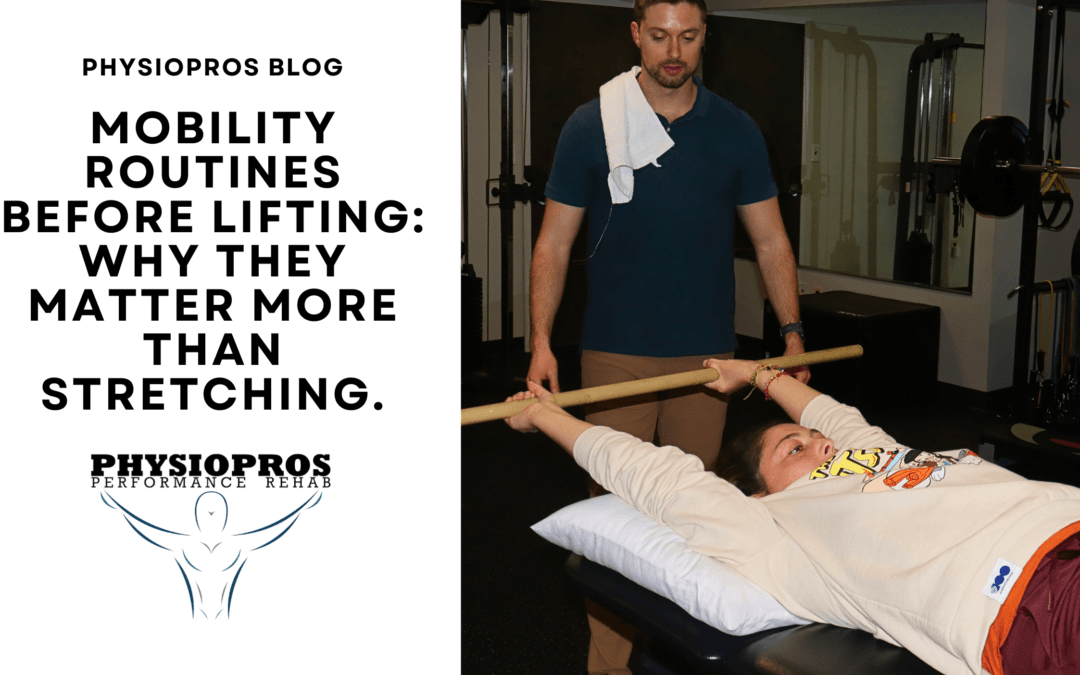
Mobility Routines Before Lifting: Why They Matter More Than Stretching.
You’re about to start your lift.
Maybe it’s leg day. Maybe you’re pressing overhead. Or maybe you’ve only got 45 minutes before work and you want to get after it.
So, like most people, you bend down, hold a hamstring stretch for 20 seconds, pull your arm across your chest, maybe sit in a quad stretch—and then jump straight into your first working set.
However, your hips still feel tight. Your shoulders feel stiff. Your squat doesn’t feel smooth until the third set. In other words, even though you “warmed up,” your body doesn’t quite feel ready.
That’s exactly where mobility routines come in.
At Physiopros Performance Rehab in Parsippany, New Jersey, we work with active adults and athletes who want to lift stronger, move better, and avoid setbacks. Time and time again, we see the same pattern. It’s not a lack of effort. It’s not a lack of discipline. Instead, it’s relying on static stretching when the body actually needs targeted, controlled mobility work.
More importantly, lifting isn’t just about flexibility—it’s about strength, coordination, and control through full ranges of motion. Therefore, if your warm-up doesn’t address those components, it’s incomplete.
So let’s break down why mobility routines matter more than stretching before lifting, how they improve performance, and, most importantly, how to structure them properly so your body feels ready from the very first set.
What Are Mobility Routines?
First off, mobility routines are structured movement sequences designed to improve joint range of motion, muscle activation, and control simultaneously.
Unlike static stretching—which simply lengthens a muscle temporarily—mobility routines focus on:
Joint movement through controlled ranges
Strength within those ranges
Neuromuscular coordination
Preparing tissues for load
In other words, mobility routines prepare you to lift. Stretching alone doesn’t.
When done correctly, they help you move more efficiently under load instead of just feeling looser for a few minutes.
Why Stretching Alone Isn’t Enough Before Lifting
Stretching has its place. It can reduce short-term stiffness and increase passive flexibility. However, lifting requires active control, not just flexibility.
When you hold a static stretch:
You’re not training strength
You’re not training coordination
You’re not preparing tissues for force production
You’re not rehearsing the movement pattern
In fact, excessive static stretching immediately before heavy lifting may temporarily reduce force output.
That’s why mobility routines are a better pre-lift strategy. They prepare joints and muscles to produce force through controlled motion.
How Mobility Routines Improve Lifting Performance
When you perform a proper mobility routine before lifting, several things happen.
1. Improved Joint Range of Motion
For example, ankle mobility affects squat depth. Limited dorsiflexion can force your heels to rise or your knees to cave inward.
Targeted mobility drills help improve usable range of motion—not just flexibility, but motion you can control.
2. Better Muscle Activation
If your glutes aren’t firing well, your lower back may compensate during squats or deadlifts.
Mobility routines often include activation drills that “wake up” key muscle groups before loading them.
3. Enhanced Movement Mechanics
Practicing controlled movement before lifting reinforces proper patterns.
This supports:
Stronger squats
Safer deadlifts
More stable overhead presses
Improved bench positioning
4. Reduced Injury Risk
When joints move efficiently and muscles activate properly, stress distributes more evenly.
That helps reduce strain on:
Knees
Shoulders
Lower back
Elbows
In a performance-based physical therapy setting like ours in Parsippany, NJ, we focus heavily on improving movement quality—not just reducing pain.
The Difference Between Flexibility and Mobility
This distinction matters.
Flexibility is the ability of a muscle to lengthen.
Mobility is the ability of a joint to move actively through a full range of motion with control.
You can be flexible but unstable.
You can also be strong but restricted.
Mobility routines bridge the gap between flexibility and strength. They train control within motion—which is exactly what lifting demands.
Common Mistakes Before Lifting
We see these patterns frequently in individuals across Morris County and Northern New Jersey.
Mistake 1: Skipping Warm-Up Entirely
Jumping straight into heavy lifts increases stress on cold tissues.
Mistake 2: Doing Random Stretches
Pulling on tight muscles without addressing joint mechanics or activation rarely solves the root issue.
Mistake 3: Spending Too Long Stretching
A pre-lift mobility routine should take 8–12 minutes, not 30.
Mistake 4: Ignoring Weak Links
If your hip mobility limits your squat, you need targeted drills—not more hamstring stretching.
What a Smart Pre-Lift Mobility Routine Looks Like
A proper routine should be specific to your lift.
Before Lower-Body Lifting
Focus on:
Ankle mobility drills
Hip flexor mobility
Glute activation
Core control
Controlled squat patterns
Examples may include:
Half-kneeling ankle drives
Hip airplanes
Glute bridges
Bodyweight squats with tempo
Before Upper-Body Lifting
Focus on:
Thoracic spine mobility
Shoulder blade control
Rotator cuff activation
Core stability
Examples may include:
Quadruped thoracic rotations
Band pull-aparts
Wall slides
Scapular push-ups
These drills prepare the body for load without fatiguing it.
How Mobility Routines Support Long-Term Joint Health
Consistent mobility work improves tissue tolerance over time.
When you repeatedly move joints through full, controlled ranges:
Connective tissue adapts
Strength improves in end ranges
Coordination sharpens
Compensations decrease
Over time, this reduces the likelihood of overuse injuries and recurring pain.
At Physiopros Performance Rehab, we often integrate mobility routines into treatment plans for people dealing with:
Shoulder impingement
Knee pain with squatting
Hip tightness
Low back discomfort
Recurrent lifting injuries
The goal isn’t just short-term relief—it’s long-term resilience.
Mobility Routines and Load Management
Another important factor is load progression.
Mobility routines don’t replace smart programming. Instead, they support it.
If you dramatically increase training volume or intensity, even perfect mobility won’t prevent irritation.
However, when mobility routines are combined with gradual load progression, recovery improves and performance increases.
How Physical Therapy Helps Optimize Your Mobility Routine
If you’re unsure which drills are right for you, an assessment makes a difference.
At Physiopros Performance Rehab in Parsippany, NJ, we evaluate:
Joint mobility
Strength deficits
Movement patterns
Lifting mechanics
Previous injury history
From there, we build a targeted plan that fits your training goals.
Because sessions are hands-on and movement-focused, we don’t just give you exercises—we coach them properly and progress them intelligently.
Practical Tips to Improve Your Pre-Lift Mobility Today
You can start with these guidelines:
Keep your mobility routine under 12 minutes
Match drills to the lift you’re performing
Focus on controlled movement, not speed
Avoid long static holds before heavy lifts
Progress mobility over time
Consistency matters more than complexity.
When to Seek Help
If you notice:
Persistent stiffness despite warming up
Pain during specific lifts
Recurrent injuries
Limited range that affects technique
One side consistently feeling tighter
It’s worth getting evaluated.
Final Thoughts
Finally, mobility routines aren’t just trendy warm-ups. They’re a foundational part of lifting well.
While stretching can temporarily reduce stiffness, mobility routines prepare your joints and muscles for real work. They improve performance, support joint health, and reduce injury risk.
If you want to lift stronger and move better—not just feel looser for five minutes—a structured mobility plan is essential.
Now, if you’re ready to improve your movement and optimize your lifting, we’re here to help.
Book a session at Physiopros Performance Rehab in Parsippany, NJ
📍3799 US-46, Suite 110, Parsippany, NJ 07054
Also, make sure to follow us on social media:
Instagram:https://www.instagram.com/physioprospt/?hl=en
Facebook:https://www.facebook.com/physioprospt0
TikTok:https://www.tiktok.com/@physioprospt?_t=8lfj7ogbgam&_r=1.
Submit a Comment