Knee Pain When Squatting: 3 Common Causes
You lower into a squat and there it is again—a pinch behind the kneecap, an ache at the front of the knee, or discomfort that only appears at a certain depth.
Knee pain when squatting can make you question your technique, mobility, or whether you should squat at all.
However, knee pain when squatting is a symptom, not a diagnosis. Where the pain occurs, when it appears, and how your knee responds afterward can all provide clues.
Here are three common causes and what you can do about them.
Cause #1: Patellofemoral Pain
If your pain is around or behind the kneecap, patellofemoral pain may be one possibility.
This type of knee pain commonly appears during squatting, running, jumping, stairs, or prolonged sitting.
As you squat deeper, your quadriceps work harder and the forces around the kneecap increase. That is not automatically harmful. Your knees are designed to tolerate load.
Problems can develop, however, when the demands of your training increase faster than your knee can adapt.
Maybe you recently:
- Increased your squat weight
- Added another leg day
- Increased running mileage
- Started jumping or sprinting more
- Returned to training after time off
Physical therapy may address more than the painful area itself. Quadriceps strength, hip strength, ankle mobility, squat mechanics, and training volume can all influence how your knee handles a squat.
The solution may eventually include more squatting—not avoiding it forever—but with an appropriate depth, resistance, and progression.
Cause #2: Patellar Tendon Overload
If your pain is more localized just below the kneecap, the patellar tendon may be involved.
The patellar tendon helps transfer force from your quadriceps through the knee. As a result, it works hard during squatting, running, jumping, and landing.
Patellar tendon irritation may become more noticeable with:
- Heavy or deep squats
- Lunges
- Jumping
- Sprinting
- Basketball or volleyball
- Repeated lower-body training
Sometimes the knee even feels better once you warm up, only to become irritated again afterward.
Rest Is Not Always the Answer
Temporarily reducing painful activity may help settle symptoms, but avoiding load indefinitely does not rebuild the tendon’s capacity.
Instead, rehab often involves gradually loading the knee through exercises such as squats, knee extensions, split squats, leg presses, and eventually jumping when appropriate.
The important part is finding the right dose.
Your knee may need better loading, not simply more loading.
Cause #3: Mobility, Strength, and Training Demands
Sometimes there is not one structure responsible for the pain.
Instead, several factors may be contributing.
A squat involves your ankles, knees, hips, and trunk. If one area is limited, the rest of the body may change how it performs the movement.
Ankle Mobility
Your ankle needs enough dorsiflexion—the ability for the shin to move forward over the foot—to squat comfortably.
Limited ankle mobility can change squat mechanics.
You may notice that you:
- Lift your heels
- Turn your feet far outward
- Shift toward one side
- Struggle to reach depth
- Feel one ankle is noticeably stiffer
That does not mean ankle stiffness causes every case of knee pain when squatting, but it can be worth assessing.
Strength and Training Load
Your quadriceps control the knee as you lower and help you stand back up. Meanwhile, your hips help control the position of the entire leg.
You may be strong enough for your usual daily activities but not prepared for the volume or weight you are asking your body to handle in the gym.
Sometimes pain begins after adding weight, sets, running mileage, or another lower-body workout too quickly.
Does Knee Pain Mean Your Squat Form Is Bad?
Not necessarily.
There is no single perfect squat for everyone.
Your anatomy, mobility, training goals, injury history, and limb lengths can all influence how your squat looks.
Instead of trying to copy someone else’s exact technique, consider whether you can perform the movement with adequate control and tolerance for your goals.
Small changes in stance, depth, load, or exercise variation can sometimes make a significant difference.
Should You Stop Squatting?
Not always.
In many cases, modifying the squat is more useful than removing it completely.
You might temporarily change:
Depth: Use a range that is better tolerated.
Weight: Reduce resistance while maintaining the movement.
Volume: Perform fewer sets or repetitions.
Tempo: Slow the movement down.
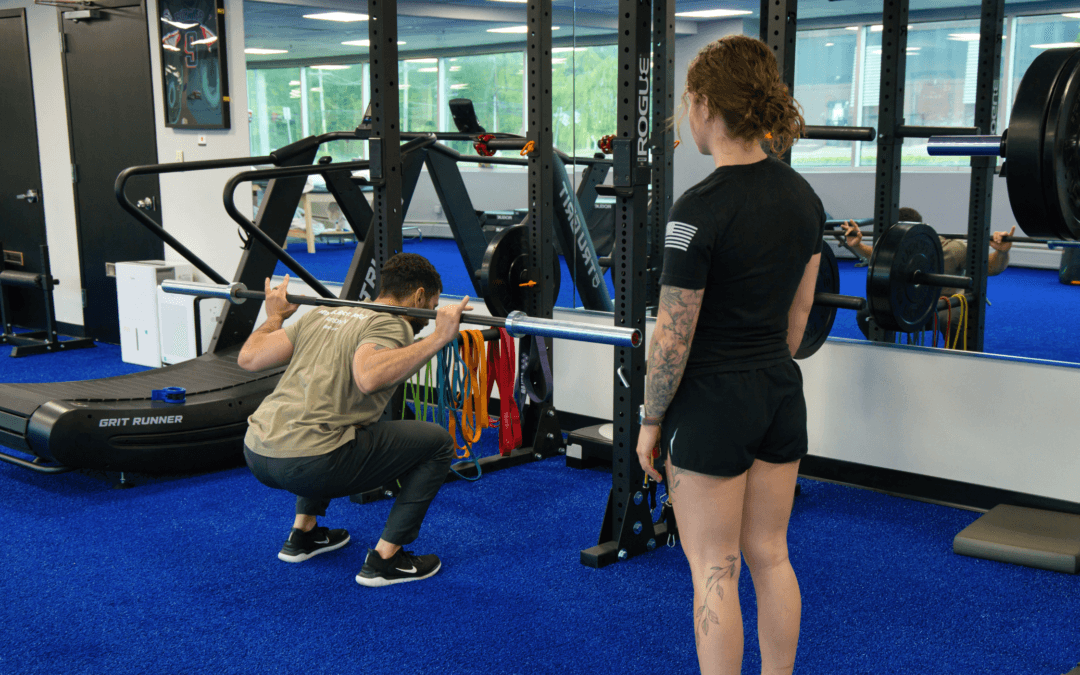
Variation: Try a box squat, goblet squat, split squat, or leg press.
As your knee improves, those variables can gradually progress.
The goal is to find a starting point your knee can handle rather than avoiding squatting indefinitely.
What a Physical Therapist May Look At
Two people can both say, “My knee hurts when I squat,” while having completely different reasons for their symptoms.
That is why a physical therapy evaluation may look at:
- Squat mechanics
- Knee range of motion
- Ankle mobility
- Hip mobility
- Quadriceps strength
- Hip strength
- Single-leg control
- Training volume
- Running or jumping demands
- Differences between each leg
For a lifter, the goal may be returning to heavier squats and lunges.
For a runner, treatment may also address mileage and lower-body strength.
For an athlete, rehab may progress toward jumping, landing, sprinting, and changing direction.
When Should Knee Pain Be Evaluated?
Consider getting your knee checked if the pain keeps returning, limits your training, causes you to shift away from one leg, or is not improving after modifying your workouts.
A physical therapist can help determine whether the issue appears related to load tolerance, strength, mobility, movement mechanics, or another condition that needs further evaluation.
Stop Working Around Your Knee
It is easy to keep removing exercises every time your knee hurts.
But eventually, your entire workout can become built around avoiding the problem.
Instead, figuring out why you have knee pain when squatting gives you a clearer path forward.
At Physiopros Performance Rehab in Parsippany, NJ, we use a personalized, movement-based approach to help active adults and athletes rebuild strength, mobility, and confidence for the activities they want to perform.
If knee pain keeps interfering with your squats, workouts, or sports, schedule an evaluation and find out what your knee actually needs.
Call Physiopros Performance Rehab at (973) 265-8621 or request an appointment by clicking here.
Also, make sure to follow us on social media:
Instagram: https://www.instagram.com/physioprospt/?hl=en
Facebook: https://www.facebook.com/physioprospt0
TikTok: https://www.tiktok.com/@physioprospt?_t=8lfj7ogbgam&_r=1.