Meniscus Tear Rehab: Can You Recover Without Surgery?
You twist your knee during a workout, feel a sharp pain, and notice swelling later that day.
After an evaluation, you learn that you have a torn meniscus.
Your first thought might be, Do I need surgery, or can physical therapy help me recover?
The answer depends on the type of tear, your symptoms, and what you want to return to doing.
For many people, meniscus tear rehab can improve knee strength, mobility, and function without surgery. However, certain injuries require a different approach, particularly when a torn piece of the meniscus interferes with normal knee movement.
Understanding the difference can help you make informed decisions about your recovery.
What Happens When You Tear Your Meniscus?
Your knee contains two menisci: C-shaped pieces of cartilage that sit between your thighbone and shinbone.
They help distribute force, absorb shock, and support knee stability during walking, squatting, running, and other activities.
A meniscus tear can happen suddenly when you twist or pivot on a planted foot. However, tears can also develop gradually as the tissue changes over time.
Common symptoms include:
- Pain along the inside or outside of the knee
- Swelling or stiffness
- Discomfort when squatting or twisting
- Difficulty fully bending or straightening the knee
- Catching or locking sensations
Not everyone experiences the same symptoms. Some people can continue walking with a meniscus tear, while others have significant pain or movement restrictions.
Can a Meniscus Tear Heal Without Surgery?
It is possible to recover good knee function without surgery, but that does not necessarily mean the torn tissue will heal completely.
The meniscus has different regions with different blood supplies.
The outer portion receives more blood flow, giving some tears in this area a greater potential to heal.
In contrast, the inner portion has a limited blood supply, making healing more difficult.
However, whether the tissue heals and whether your knee can function comfortably are two different questions.
Physical therapy does not mechanically repair a torn meniscus. Instead, it can help improve strength, mobility, movement tolerance, and your ability to perform daily activities.
For some people, these improvements are enough to return to their usual activities without surgery.
What Does the Research Say About Physical Therapy vs. Surgery?
Research provides encouraging evidence for people considering nonsurgical treatment, particularly those with degenerative meniscus tears.
Degenerative tears develop gradually and are more common as people age.
A randomized clinical trial involving 321 adults between the ages of 45 and 70 compared exercise-based physical therapy with arthroscopic partial meniscectomy, a procedure that removes part of the damaged meniscus.
At the five-year follow-up, researchers found no clinically meaningful difference in patient-reported knee function between the treatment groups.
Physical therapy produced improvements in knee function that were not inferior to surgery in this study population.
However, these findings do not mean that every meniscus tear should be treated without surgery.
A younger athlete with a displaced traumatic tear may need a different treatment approach than an older adult with a degenerative tear.
The type of injury matters.
When Might Surgery Be Necessary?
Some meniscus injuries require early evaluation by an orthopedic specialist.
For example, a displaced tear may cause a piece of the meniscus to interfere with knee movement. This can prevent the knee from fully straightening.
Certain acute tears may also be suitable for surgical repair, particularly when the damaged tissue has the potential to heal.
The American Academy of Orthopaedic Surgeons notes that early surgical intervention may benefit patients with displaced acute tears that restrict knee motion or symptomatic tears that could benefit from repair.
Surgery may also be considered when an appropriate course of nonsurgical treatment does not adequately improve symptoms.
If your knee becomes physically locked, you cannot bear weight after an injury, or you experience significant swelling or severe pain, seek prompt medical evaluation rather than trying to exercise through the problem.
What Does Meniscus Tear Rehab Actually Include?
A meniscus tear rehab program should address more than pain.
Your knee needs enough mobility, strength, and control to tolerate the activities you want to perform.
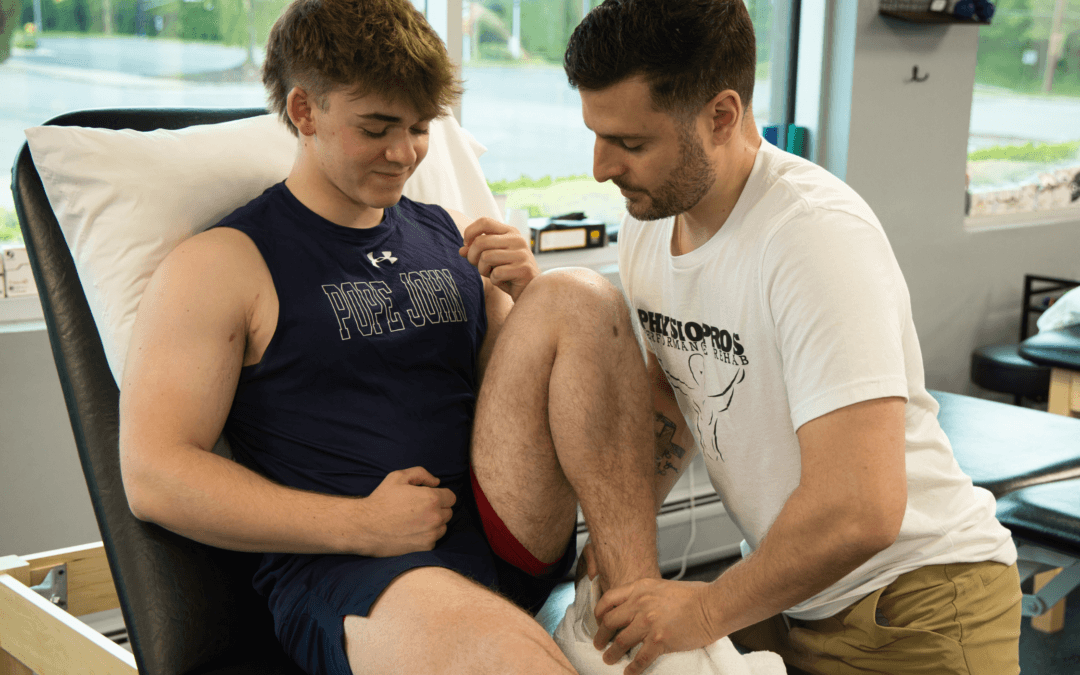
At Physiopros Performance Rehab, your physical therapist can assess how your knee moves and responds to loading before developing an individualized treatment plan.
Depending on your injury and symptoms, rehabilitation may include the following components.
1. Restoring Knee Mobility
After a meniscus injury, swelling and discomfort can make it difficult to fully bend or straighten your knee.
Early rehab may include gentle range-of-motion exercises to restore comfortable movement.
However, aggressive stretching or forcing the knee into painful positions is not the goal.
If a displaced tear is physically blocking movement, further medical evaluation may be necessary.
2. Rebuilding Quadriceps Strength
Your quadriceps play an important role in controlling the knee during walking, stairs, squatting, and running.
After a knee injury, pain and swelling can make it harder to activate these muscles effectively.
Depending on your symptoms, strengthening may begin with exercises such as:
- Quadriceps contractions
- Straight-leg raises
- Supported sit-to-stands
- Step-ups
- Modified squats
As your knee tolerates more activity, the exercises can become progressively more challenging.
3. Improving Single-Leg Control
Eventually, your knee needs to do more than move comfortably while sitting or lying down.
Walking, climbing stairs, and many athletic movements require you to support your body weight on one leg.
Single-leg balance, step-downs, and controlled strengthening exercises can help rebuild the coordination needed for these activities.
Your physical therapist may also assess hip and ankle strength because they contribute to how your entire leg moves.
4. Gradually Returning to Activity
The final stage of meniscus tear rehab should reflect your goals.
For someone who enjoys lifting, that may involve gradually returning to deeper squats and heavier lower-body exercises.
For a runner, rehabilitation may include walking progressions followed by a gradual return to running.
For an athlete, the program may eventually involve jumping, landing, cutting, and sport-specific drills.
Being able to walk without pain does not automatically mean your knee is ready for every activity.
The goal is to progressively rebuild your ability to handle the demands of your normal routine.
How Long Does Meniscus Tear Rehab Take?
Recovery time varies depending on the type of tear, your symptoms, overall knee health, and activity goals.
Some people notice meaningful improvement within several weeks. Others require a longer rehabilitation program, especially when returning to demanding sports or training.
Rather than focusing only on a specific timeline, pay attention to functional progress.
Are you walking more comfortably? Is your range of motion improving? Can you tolerate more challenging strengthening exercises without increased swelling or significant pain afterward?
These changes help guide your progression.
If your symptoms are not improving with an appropriate rehabilitation program, your physical therapist and medical provider can discuss whether additional evaluation or treatment is needed.
What If You Already Had Meniscus Surgery?
Physical therapy also plays an important role after meniscus surgery.
However, rehabilitation following a meniscus repair is different from rehabilitation after a partial meniscectomy.
A repaired meniscus needs time to heal, and your surgeon may initially restrict weight-bearing, knee bending, or certain exercises.
Therefore, postoperative rehabilitation should follow your surgeon’s specific protocol rather than a general meniscus exercise program.
As healing progresses, physical therapy can help restore mobility, strength, balance, and eventually the ability to return to your desired activities.
Meniscus Tear Rehab at Physiopros Performance Rehab
A meniscus tear does not automatically mean you need surgery or that you have to give up your favorite activities.
However, the right treatment depends on understanding your injury and what your knee needs to recover.
At Physiopros Performance Rehab in Parsippany, NJ, we use a personalized, movement-based approach to physical therapy.
Whether your goal is walking without discomfort, returning to the gym, or getting back to sports, your rehabilitation plan can address the strength, mobility, and movement demands relevant to your recovery.
Our team works with active adults and athletes throughout Parsippany, Morris County, and Northern New Jersey.
Ready to find out what your knee needs?
Schedule an evaluation at Physiopros Performance Rehab to discuss your symptoms and develop a rehabilitation plan that supports your recovery.
Call Physiopros Performance Rehab at (973) 265-8621 or request an appointment by clicking here.
Also, make sure to follow us on social media:
Instagram: https://www.instagram.com/physioprospt/?hl=en
Facebook: https://www.facebook.com/physioprospt0
TikTok: https://www.tiktok.com/@physioprospt?_t=8lfj7ogbgam&_r=1.