MCL Sprain Rehab: What to Expect During Recovery
You plant your foot, change direction, and suddenly feel pain along the inside of your knee.
Maybe another player hit the outside of your leg. Or perhaps your knee simply collapsed inward during a cut, landing, or awkward step.
After the initial swelling settles, the big question becomes: What happens next?
For many people, MCL sprain rehab does not require surgery. Instead, recovery focuses on gradually restoring knee motion, strength, balance, and confidence before progressing back to running or sports.
Exactly how that process looks depends on how severe the sprain is and whether any other structures in the knee were injured.
Here is what you can generally expect.
What Is an MCL Sprain?
The medial collateral ligament, or MCL, is located along the inside of your knee. It helps resist forces that push the knee inward and contributes to overall knee stability.
MCL injuries commonly happen after a blow to the outside of the knee or when the knee twists while the foot remains planted. Football, soccer, basketball, skiing, and other sports involving contact or quick direction changes can all produce this type of injury.
An MCL injury is usually classified by severity:
Grade I: The ligament is stretched but remains largely intact.
Grade II: A partial tear has occurred.
Grade III: The ligament is completely torn and the knee may feel significantly less stable.
You may notice pain along the inside of the knee, swelling, stiffness, difficulty bending or straightening the knee, or a sensation that the knee could buckle.
The grade matters, but it is not the only thing that determines your recovery.
The Good News: Many MCL Sprains Heal Without Surgery
Unlike some other major knee ligament injuries, isolated MCL sprains frequently respond well to conservative treatment.
Even some complete MCL tears can be managed without surgery depending on the location of the injury, knee stability, activity demands, and whether other ligaments are involved.
That does not mean you should simply rest until the pain disappears.
A successful MCL sprain rehab program should gradually restore what the injury took away.
Early Recovery: Protect the Knee and Restore Motion
During the first stage of recovery, pain and swelling may make walking or bending the knee difficult.
The immediate priority is usually to protect the injured ligament while preventing unnecessary stiffness.
Depending on the severity of the injury, your healthcare provider may recommend crutches or a hinged knee brace. Weight-bearing and range-of-motion recommendations should be based on the individual injury rather than a universal timeline.
Early physical therapy may focus on:
- Reducing pain and swelling
- Improving comfortable knee bending and straightening
- Restoring a normal walking pattern
- Activating the quadriceps
- Maintaining strength in the surrounding muscles
Simple exercises such as quadriceps contractions, straight-leg raises, gentle range-of-motion work, and eventually stationary cycling may be introduced as tolerated.
The goal is not to rush.
However, keeping the knee completely still for longer than necessary is usually not the goal either.
Next Step: Rebuild Knee Strength
Once walking and knee motion become more comfortable, rehabilitation begins shifting toward strength.
Your quadriceps and hamstrings are especially important because they help control and stabilize the knee.
Exercises may progress toward:
- Sit-to-stands
- Squats
- Step-ups
- Bridges
- Hamstring strengthening
- Leg presses
- Split squats
The exact exercises should depend on how your knee responds.
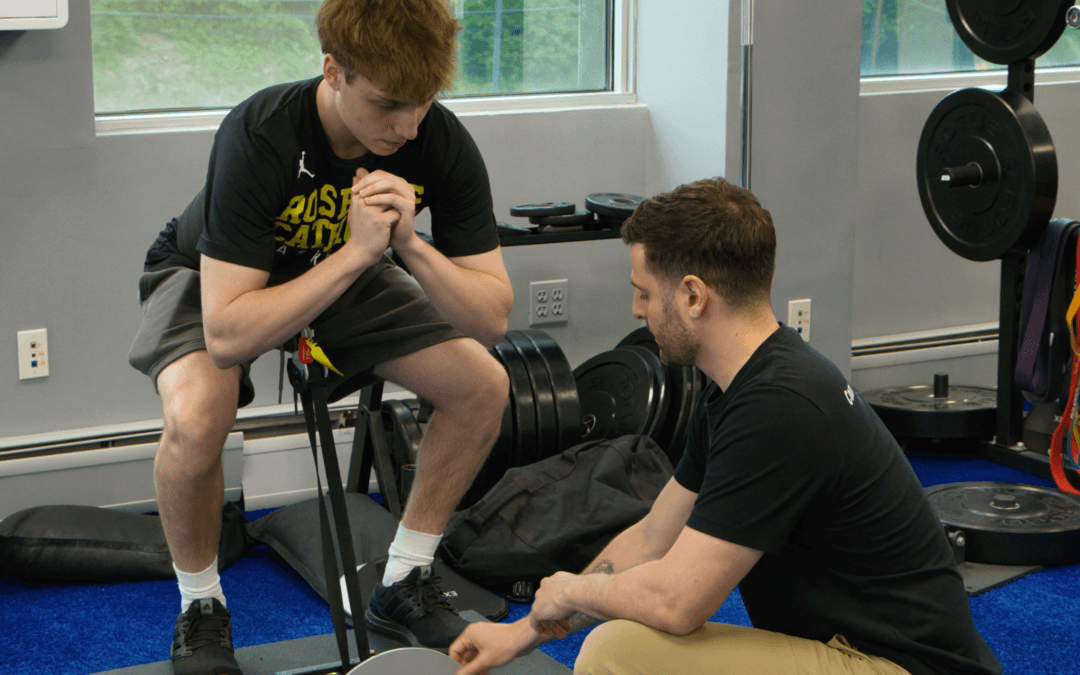
For example, a shallow squat may be appropriate before a deeper squat. A supported split squat may come before a heavier loaded variation.
Progressive strengthening is a central component of MCL rehabilitation and is typically advanced as pain, motion, and stability improve.
Balance and Single-Leg Control Matter Too
Strength is important, but your knee also needs to react and stabilize during movement.
That becomes especially important if you plan to return to sports.
After an MCL sprain, balance and proprioception—the body’s ability to sense joint position—may need to be retrained.
Your program might begin with simple single-leg balance and later progress toward:
- Single-leg squats
- Step-downs
- Multi-directional reaches
- Unstable-surface exercises
- Single-leg strength work
- Controlled landing drills
These exercises challenge your knee to stay controlled while the rest of your body moves around it.
For athletes, this stage starts bridging the gap between basic rehabilitation and sport.
When Can Running Start Again?
Getting back to running should be based on function, not simply how many weeks have passed.
Before running, you should generally be making good progress with walking, knee range of motion, strength, and single-leg control.
From there, you may begin with straight-line jogging.
If the knee tolerates that well, progression may include:
Straight-line running → faster running → acceleration and deceleration → lateral movement → cutting → sport-specific drills.
Rehabilitation reviews emphasize restoring motion, strength, proprioception, and functional control before returning to demanding activity.
That progression becomes particularly important in sports such as soccer, football, basketball, lacrosse, and skiing.
Running straight ahead is only part of what your knee needs to handle.
How Long Does MCL Sprain Rehab Take?
Recovery varies considerably based on injury severity.
A mild isolated Grade I sprain may recover relatively quickly, while a Grade II or Grade III injury typically requires more rehabilitation.
One review of acute knee injuries reported broad return-to-sport ranges of approximately:
- Grade I: 2–4 weeks
- Grade II: 4–6 weeks
- Grade III: 6–8 weeks
However, these are general estimates—not deadlines.
Associated injuries, persistent instability, sport demands, strength deficits, and individual healing can all extend the timeline.
A soccer player returning to cutting and contact may need more preparation than someone whose primary goal is comfortable walking and strength training.
That is why MCL sprain rehab should be criteria-based whenever possible rather than based only on the calendar.
What Does Return-to-Sport Testing Look At?
Pain disappearing is encouraging, but it does not automatically mean your knee is ready for competition.
Before returning to sport, your physical therapist may assess:
- Knee range of motion
- Quadriceps and hamstring strength
- Single-leg control
- Balance
- Running mechanics
- Jumping and landing
- Change-of-direction ability
- Sport-specific movements
- Confidence in the injured knee
At Physiopros Performance Rehab, objective testing can also be incorporated when appropriate to help guide return-to-sport decisions.
The goal is not simply to pass one test.
It is to determine whether your knee can handle the demands you are about to place on it.
What If Your Knee Still Feels Unstable?
Persistent instability deserves attention.
While many isolated MCL injuries recover without surgery, more severe injuries can occur alongside damage to the ACL, meniscus, or other structures within the knee.
Further medical evaluation may be appropriate if your knee repeatedly gives way, remains significantly swollen, cannot fully bend or straighten, or does not progress as expected.
You should also seek prompt evaluation after the initial injury if you cannot comfortably bear weight, experience major swelling, notice a deformity, or feel that the knee is significantly unstable.
An MRI is not necessary for every MCL sprain, but it may be used when the diagnosis is unclear or when another knee injury is suspected.
MCL Sprain Rehab at Physiopros Performance Rehab
The goal of MCL rehabilitation is not simply to wait until the inside of your knee stops hurting.
Your knee should gradually become strong enough and stable enough for the activities you want to return to.
At Physiopros Performance Rehab in Parsippany, NJ, rehabilitation can progress from restoring comfortable knee movement to strength training, single-leg control, running, jumping, agility, and return-to-sport preparation.
For an active adult, that might mean getting back to lifting or everyday activity.
For an athlete, it may mean rebuilding the ability to sprint, cut, land, and react confidently without constantly thinking about the injured knee.
Your recovery should reflect those goals.
If your knee still feels painful, weak, or unstable after an MCL injury, schedule an evaluation at Physiopros Performance Rehab and develop a rehabilitation plan around what your knee actually needs.
Call Physiopros Performance Rehab at (973) 265-8621 or request an appointment by clicking here.
Also, make sure to follow us on social media:
Instagram: https://www.instagram.com/physioprospt/?hl=en
Facebook: https://www.facebook.com/physioprospt0
TikTok: https://www.tiktok.com/@physioprospt?_t=8lfj7ogbgam&_r=1.
Submit a Comment