
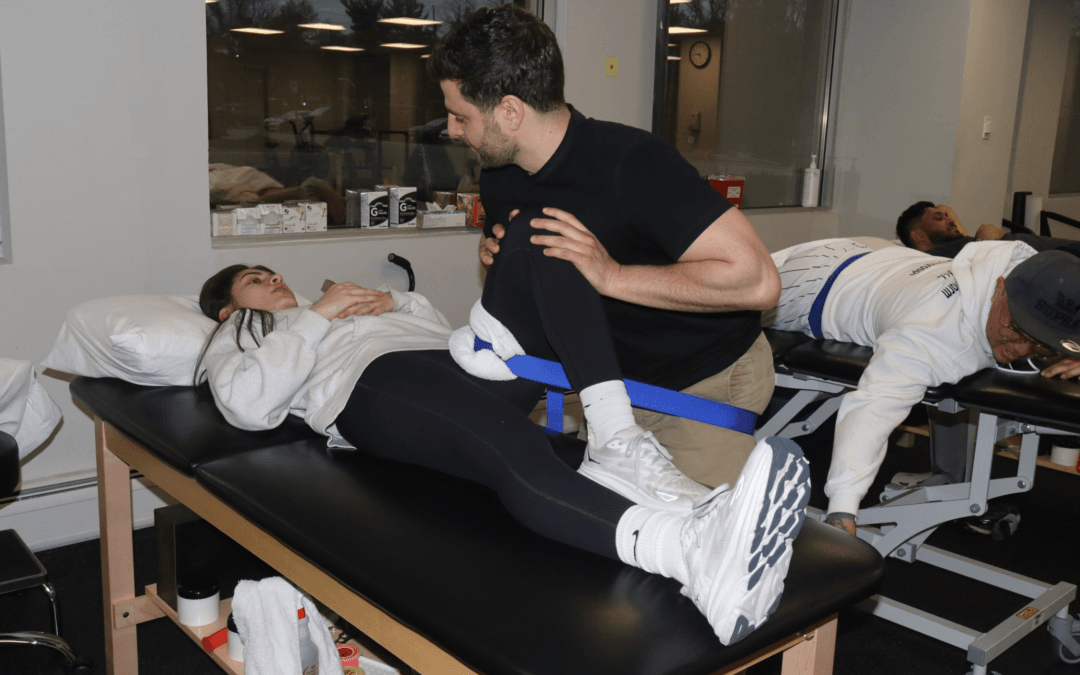
IT Band Syndrome: Why Your Outer Knee Hurts When Running
You start your run feeling fine.
Then, a few miles in, a sharp or burning pain begins building along the outside of your knee.
Maybe you can finish the run. Maybe the pain becomes strong enough that you have to stop. Then, after some rest, your knee feels almost normal again—until the next run.
That pattern is common with IT Band Syndrome, one of the more frequent causes of outer knee pain in runners.
But despite the name, the solution is usually not as simple as “stretch your IT band.”
Running volume, hip strength, lower-body control, and the way your body handles repeated loading can all play a role.
What Is IT Band Syndrome?
The iliotibial band, or IT band, is a thick band of connective tissue that runs along the outside of your thigh from your hip toward your knee.
IT Band Syndrome, also called iliotibial band syndrome or ITBS, typically causes pain near the outside of the knee and is particularly common among runners and endurance athletes. A 2026 systematic review described ITBS as a leading cause of lateral knee pain in these populations.
Symptoms commonly include:
- Pain on the outside of the knee
- Burning or aching during running
- Pain that begins after a predictable distance
- Symptoms when running downhill
- Tenderness near the outside of the knee
- Pain that settles when running stops
For some runners, the knee feels completely normal during everyday activities.
Then running brings the pain right back.
Why Does IT Band Syndrome Hurt When You Run?
Running involves thousands of repeated loading cycles.
Every time your foot hits the ground, your hip, knee, ankle, and trunk work together to control your body and absorb force.
When the amount of running you are doing exceeds what your body is currently prepared to tolerate, symptoms may develop.
A 2026 systematic review examining knee injuries in endurance runners found that previous injury, training load, and biomechanical factors were among the recurring risk factors for running-related knee problems.
For IT Band Syndrome specifically, your physical therapist may consider factors such as:
- Recent increases in mileage
- More hills than usual
- Increased running frequency
- Faster workouts
- Hip strength
- Single-leg control
- Running mechanics
- Recovery between sessions
It is rarely useful to blame one muscle or one movement without looking at the bigger picture.
Your Training Load May Be the First Clue
Think about when your symptoms started.
Did you recently increase your long run?
Add a fourth or fifth running day?
Start hill training?
Return after several weeks off?
Begin preparing for a race?
These changes matter.
Your cardiovascular fitness may improve quickly, but your muscles, tendons, and other tissues still need time to adapt to greater running volume.
That is why someone can feel fit enough to run farther while their body is not yet prepared for the additional repetitive loading.
When symptoms appear, the answer may not be to stop running forever.
Instead, you may need to temporarily reduce the amount or intensity of running and rebuild gradually.
Is a “Tight IT Band” Really the Problem?
This is where IT Band Syndrome becomes misunderstood.
Many runners immediately start aggressively foam rolling the outside of the thigh because they have been told their IT band is tight.
Foam rolling or stretching may feel good, and they can be included in some rehabilitation programs.
However, they should not automatically become the entire treatment plan.
In other words, mobility work may have a role.
But simply trying to “loosen the IT band” does not address your running workload, hip strength, or movement control.
Hip Strength May Matter
Your hips help control the position of your pelvis, thigh, and knee every time you land on one leg.
And running is essentially thousands of repeated single-leg landings.
Research on conservative treatment for runners with IT Band Syndrome frequently includes hip abductor strengthening as part of rehabilitation. A 2024 systematic review found that hip-strengthening exercises were one of the most common approaches associated with improvements in pain and function.
That does not mean weak hips are the sole cause of IT Band Syndrome.
However, improving strength may help your lower body tolerate running more effectively.
Exercises may include:
- Side steps with resistance
- Single-leg bridges
- Step-downs
- Split squats
- Single-leg squats
- Hip abduction exercises
As symptoms improve, the exercises should gradually become more demanding.
Strengthening Should Go Beyond the Hip
Your knee does not function independently from the rest of your leg.
Therefore, a rehabilitation program may also include quadriceps, calf, hamstring, and single-leg strengthening.
A small 2026 study compared manual therapy with hip- and knee-focused strengthening in runners with IT Band Syndrome. Both groups improved over six weeks, but the strengthening group experienced greater improvements in pain and function.
Again, this does not mean one exercise program works for everyone.
It reinforces a more important idea:
Building capacity matters.
If your goal is to run several miles without pain, your rehabilitation eventually needs to prepare your legs for several miles of repeated loading.
What About Your Running Form?
Running mechanics can sometimes contribute to symptoms, but there is no single “perfect” running form every runner should copy.
Some runners may benefit from changes to cadence, step width, stride length, or other aspects of their gait.
Others may not need technique changes at all.
The decision should come from an actual assessment rather than guessing.
At Physiopros Performance Rehab, gait analysis can be used to evaluate how someone walks or runs and identify movement patterns that may be relevant to symptoms. From there, treatment can address mobility, strength, and motor control when appropriate.
The goal is not to make your running form look perfect.
It is to determine whether a modifiable factor may be contributing to your problem.
Can You Keep Running With IT Band Syndrome?
Possibly.
The answer depends on how your knee responds.
If you can run a shorter distance with mild symptoms that settle afterward and are not worse the next day, your rehabilitation plan may allow some continued running.
However, if the pain:
- Gets progressively worse during the run
- Changes your stride
- Forces you to stop
- Starts earlier every time you run
- Remains significantly worse afterward
then your current running load may be too high.
You may temporarily reduce mileage, frequency, hills, or speed work while strengthening and gradually rebuilding tolerance.
The goal is to find the amount your knee can currently handle and progress from there.
Should You Stop Running Hills?
Downhill running is often particularly uncomfortable for runners with IT Band Syndrome because of the repeated knee-loading demands involved.
That does not mean hills need to disappear permanently.
However, removing or reducing them temporarily can make sense if they consistently trigger symptoms.
Once your knee is tolerating easier flat running, hills can gradually return.
The same concept applies to speed work.
Rehabilitation is about managing load—not avoiding challenging activity forever.
When Is It Time to Return to Normal Mileage?
There is no perfect number of weeks.
Instead, progression should depend on how your knee is responding.
You may be ready to increase running when:
- Walking is comfortable
- Daily activities do not aggravate the knee
- Strength exercises are progressing
- Single-leg control is improving
- Short runs are tolerated
- Symptoms are not significantly worse the next morning
From there, mileage can increase gradually.
Avoid increasing long-run distance, weekly mileage, hills, and speed all at the same time.
Changing one variable at a time makes it easier to understand what your knee can tolerate.
When Outer Knee Pain May Be Something Else
Not every runner with pain on the outside of the knee has IT Band Syndrome.
Other knee conditions can produce similar symptoms.
Consider getting evaluated if your pain is persistent, worsening, associated with significant swelling, causes locking or giving way, or began after a traumatic injury.
You should also seek evaluation if reducing your running volume and performing basic strengthening does not lead to improvement.
A physical therapist can help determine whether your symptoms are consistent with IT Band Syndrome or whether another issue should be considered.
IT Band Syndrome Treatment at Physiopros
The goal of treating IT Band Syndrome should not be to endlessly foam roll the outside of your thigh.
It should be to identify why running is exceeding your knee’s current capacity and build that capacity back up.
At Physiopros Performance Rehab in Parsippany, NJ, we take a movement-based approach to running injuries.
Your physical therapist may assess:
- Running and walking mechanics
- Hip and knee strength
- Single-leg control
- Ankle and hip mobility
- Training volume
- Strength differences between sides
Treatment may then combine progressive strengthening, mobility work, gait analysis, activity modification, and a gradual return-to-running plan.
If pain on the outside of your knee keeps appearing every time you run, schedule an evaluation and find out what may be contributing to it.
Call Physiopros Performance Rehab at (973) 265-8621 or request an appointment by clicking here.
Also, make sure to follow us on social media:
Instagram: https://www.instagram.com/physioprospt/?hl=en
Facebook: https://www.facebook.com/physioprospt0
TikTok: https://www.tiktok.com/@physioprospt?_t=8lfj7ogbgam&_r=1.