5 Runner’s Knee Exercises for Stronger Hips.
Your knee hurts when you run, so why would the solution involve your hips?
Because running is a full-leg task.
Every time your foot hits the ground, your hip muscles help control the position of your pelvis, thigh, and knee. If that control fades as you get tired—or if your recent mileage, speed, or hill work exceeded what your body was prepared for—the area around the kneecap may become irritated.
Runner’s knee is commonly used to describe patellofemoral pain: discomfort around or behind the kneecap that often appears during running, stairs, squats, hills, or prolonged sitting. Sudden increases in running and jumping activity can contribute, while strength and coordination at the hip and knee may also influence symptoms.
The five exercises below emphasize hip strength, but runner’s knee is not always caused by “weak glutes.” Best-practice guidance supports education plus hip- and knee-targeted exercise, with other treatments added only when they fit the runner.
Before You Begin: Use Symptoms as Feedback
Exercise should challenge the muscles without turning the knee into the main event.
Sharp pain, increasing swelling, buckling, locking, or escalating symptoms are not signs to push harder.
Start with a range and resistance you can control. Then watch how the knee responds during the exercise, later that day, and on your next run.
Get evaluated first if pain followed a fall or twist, you cannot bear weight normally, the knee is significantly swollen, or it repeatedly gives way.
Exercise 1: Side-Lying Hip Abduction
This exercise trains the outer hip muscles that help steady the pelvis during each running stride.
How to Do It
- Lie on your side with the bottom knee bent for support.
- Keep the top leg straight and slightly behind your body.
- Point the kneecap forward instead of turning the toes toward the ceiling.
- Lift the leg slowly.
- Pause, then lower with control.
Begin with two or three sets of eight to fifteen repetitions per side.
Make It Work Better
Do not chase height. If your pelvis rolls backward or the front of your hip does most of the work, reduce the range.
To progress, add a light ankle weight or hold the top position briefly.
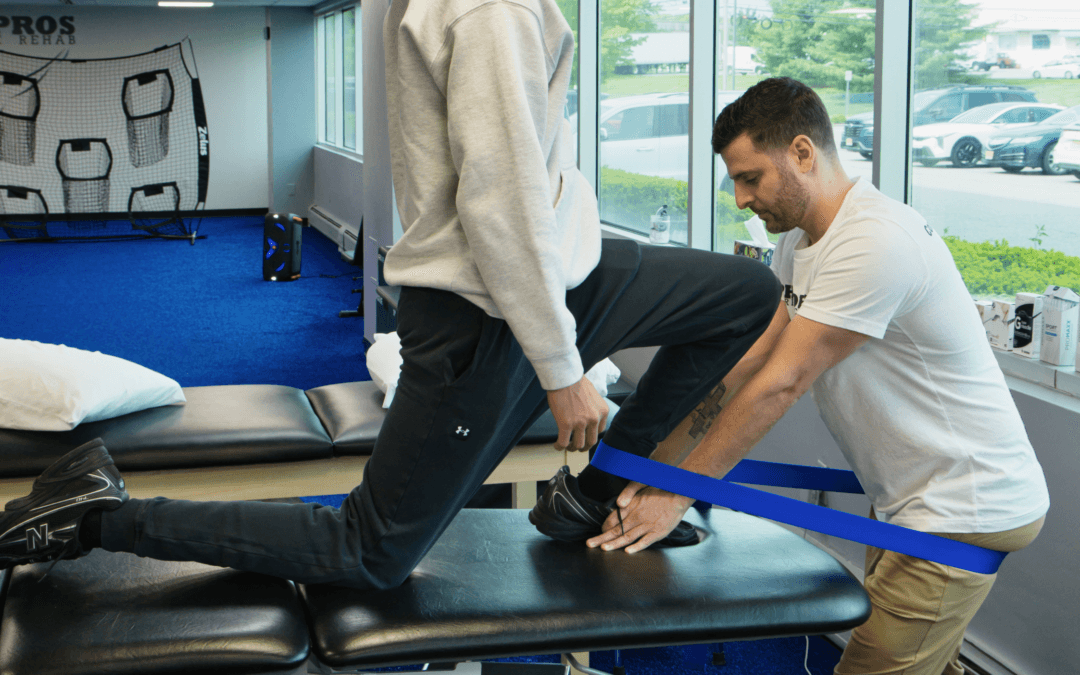
Exercise 2: Lateral Band Walk
Lateral band walks build hip control before more demanding single-leg work.
How to Do It
- Place a resistance band above your knees or around your ankles.
- Stand with your knees softly bent.
- Keep your feet facing forward.
- Step sideways without dragging the trailing foot.
- Maintain steady tension in the band.
Take eight to twelve controlled steps in each direction and repeat for two or three rounds.
Make It Work Better
Keep your torso quiet. The goal is not to sway from side to side.
A band around the ankles creates more demand than a band above the knees. Start where you can maintain alignment and feel the side of the hip working.
Exercise 3: Single-Leg Bridge
The single-leg bridge trains hip extension while asking the pelvis to stay level.
How to Do It
- Lie on your back with one knee bent and one leg lifted.
- Press through the foot on the floor.
- Tighten your abdomen gently.
- Lift your hips without twisting.
- Pause, then lower slowly.
Perform two or three sets of six to twelve repetitions per side.
Make It Work Better
If you feel the exercise mainly in the hamstring, bring the working foot slightly closer or begin with a two-leg bridge.
To progress, elevate the shoulders, add weight across the hips, or use a longer pause. Do not progress until you can keep the pelvis from dropping or rotating.
Exercise 4: Controlled Step-Down
The step-down connects hip strength to knee control.
It asks you to control the pelvis, thigh, knee, and foot while lowering on one leg, making it useful for running, stairs, and hills.
How to Do It
- Stand on a low step.
- Keep the working foot fully supported.
- Slowly lower the opposite heel toward the floor.
- Keep the pelvis level and the knee tracking comfortably over the foot.
- Tap the heel, then return to standing.
Start with two sets of six to ten repetitions.
Make It Work Better
Use a railing or wall for light balance support. If the knee hurts, reduce the step height or lower only partway.
Progress by increasing the step height, slowing the lowering phase, or holding a light weight. Quality matters more than depth.
Exercise 5: Rear-Foot-Elevated Split Squat
The rear-foot-elevated split squat trains one-leg strength through a larger range and belongs later in the progression.
How to Do It
- Place the back foot on a low bench.
- Set the front foot far enough forward to feel balanced.
- Lower straight down through a comfortable range.
- Keep the front foot planted.
- Drive through the front leg to stand.
Begin with two or three sets of six to ten repetitions per side.
Make It Work Better
Start with body weight and hold support if needed. If the front of the knee is irritated, use a shallower depth or switch to a standard split squat.
Add dumbbells only after the movement feels controlled.
Why Hip Exercises Help—but Are Not the Whole Plan
Strong hips can support better control, but runner’s knee is rarely solved by one muscle group.
A complete plan may also include:
- Quadriceps strengthening
- Calf strength
- Ankle mobility
- Running-volume changes
- Hill or speed-work adjustments
- Cadence or technique changes
- Better recovery between hard sessions
Research and clinical guidance consistently place progressive exercise and education at the center of patellofemoral pain management. Hip and knee strengthening are commonly combined because both regions contribute to the demands of running.
That is also why complete rest often disappoints runners. The knee may calm down while you are not running, yet the same symptoms can return if you resume the previous mileage without rebuilding strength and tolerance.
How Often Should You Do These Exercises?
Two or three strength sessions per week is a practical starting point for many runners, but the correct amount depends on your training experience, symptoms, and running schedule.
A simple session might include:
- One side-of-hip exercise
- One bridge or hip-extension exercise
- One single-leg squat pattern
Choose a resistance that makes the final repetitions challenging without losing control. As strength improves, gradually increase resistance instead of endlessly adding more repetitions.
When possible, keep hard lower-body strength work away from your most demanding run.
Can You Run While Doing Runner’s Knee Exercises?
Many runners do not need to stop completely.
You may be able to reduce distance, slow the pace, choose flatter routes, or use run-walk intervals while building strength.
Consider reducing your current workload if:
- Pain rises steadily as the run continues
- Your stride changes
- You limp afterward
- Symptoms remain noticeably worse the next day
- Each run starts worse than the previous one
Cross-training with cycling, pool running, or another tolerable activity can help maintain fitness while running volume is temporarily reduced. Physical therapists can also assess walking and running mechanics and guide a gradual return to full activity.
When Stronger Hips Are Not Enough
An online exercise list cannot determine why your knee hurts.
Seek an evaluation if pain is recurring, getting worse, limiting normal walking, or preventing you from progressing your training. A physical therapist may assess hip and quadriceps strength, ankle mobility, single-leg control, training history, footwear, and running form.
At Physiopros Performance Rehab in Parsippany, NJ, gait analysis and sports physical therapy can connect those findings to a personalized plan. Treatment may include progressive strengthening, running retraining, mobility work, and manual therapy when appropriate. Patients work closely with a licensed physical therapist, with a trained aide assisting as needed.
Build Strength That Carries Into Every Mile
The best runner’s knee exercises do more than create a burn in the glutes. They improve the strength and control you can use when the road gets longer, the hill gets steeper, or fatigue changes your stride.
If knee pain keeps interrupting your runs, schedule an evaluation at Physiopros Performance Rehab. We help runners throughout Parsippany, Morris County, and Northern New Jersey build a plan for stronger, more confident running.
Call Physiopros Performance Rehab at (973) 265-8621 or request an appointment online.
Also, make sure to follow us on social media:
Instagram: https://www.instagram.com/physioprospt/?hl=en
Facebook: https://www.facebook.com/physioprospt0
TikTok: https://www.tiktok.com/@physioprospt?_t=8lfj7ogbgam&_r=1.